
karelm
-
Posts
3,835 -
Joined
-
Last visited
-
Days Won
23
Recent Profile Visitors
20,841 profile views




-
He didn't really care for the blockbuster business - it didn't suit him well. He would often miss deadlines, etc., and got the reputation of being sort of unreliable. I think he was also an alcoholic at the time and seems to be in a much better place doing projects he cares about without interest in the business.
-
I like the Men of the Yorktown horn counter melody.
-
 Jurassic Shark reacted to a post in a topic:
The Composer's Thread
Jurassic Shark reacted to a post in a topic:
The Composer's Thread
-
karelm reacted to a post in a topic:
Favourite trombone moments in film music
-
Jay reacted to a post in a topic:
Favourite trombone moments in film music
-
karelm reacted to a post in a topic:
The Christopher Young Appreciation Thread
-
 ragoz350 reacted to a post in a topic:
Arnoldization
ragoz350 reacted to a post in a topic:
Arnoldization
-
For some. I happen to love orchestration. Sure, it can sometimes be frustrating like when you are orchestrating for a composer who isn't clear on what they want so you do what can work but get very specific notes of how they want it to sound that wasn't clear before. For example, if you get a melody and chord symbols, you have so, so many ways you can interpret it. But then get lots of notes about "hold the double bass till bar 39 but take out cello on 38, raise the viola's second note, make the trumpets sound like fanfares, etc.). In that example, none of the details were in the sketch so they are relying on more interpretation from the orchestrator and that can be frustrating if then they have very specific requirements. At its best, the composer sees you as a qualified composer who is an expert at orchestrating, and you are a partner in a collaboration for creating something special. I've been on those gigs, and they are wonderful. Some see it as part of composition (like Bernard Herrmann thought this way and I'd say JW does too). Others compose more in sketches then do a pass at orchestrating or hand it off to a specialist. This is more common for those with a pop/rock background. One can think of it as editing. You can edit as you write but you still need to re-edit in a different way once everything is done. What worked for a scene might not be as valid when seen in a whole.
-
karelm reacted to a post in a topic:
What is the last piece of classical music you listened to?
-
karelm reacted to a post in a topic:
The Quick Question Thread
-
karelm reacted to a post in a topic:
What is the last piece of classical music you listened to?
-
karelm reacted to a post in a topic:
What is the last piece of classical music you listened to?
-
Yavar Moradi reacted to a post in a topic:
What is the last piece of classical music you listened to?
-
 Well, so just listen to any of the Wagner/Stokowski arrangements if you want Wagner more like a symphonic poem. They are very, very good. This is an excellent 1 hour reduction of the 14 hours of the Ring. So now you're kind of in the Richard Strauss symphonic poem territory. Opera is truly unique as it combines multiple expressive devices over the course of such long a duration. I saw the 14 hour ring (across four nights) and by the end of it, I felt such a sense of catharsis, I was a puddle of tears. Many operas are that impactful - Doctor Atomic was fantastic as well. But if it's the singing you can't stand, there are different styles of opera. Obviously Wagner is a specific, shall we say Valkyrie style, then you might like Russian style like Mussorgsky or Rimsky-Korsakov better.
 -
karelm reacted to a post in a topic:
What is the last piece of classical music you listened to?
-
Jurassic Shark reacted to a post in a topic:
The Quick Question Thread
-
I just love Prokofiev but this is probably his weakest ballet. Romeo & Juliette is a freaking masterpiece. Cinderella is nice and concise. I generally favor the earlier works, finding them fierier but this ballet just seems to drag. What do you think of the Shostakovich ballets? I heard The Golden Age is excellent.
-
karelm reacted to a post in a topic:
What is the last piece of classical music you listened to?
-
This is a pretty stupid question but what is a substack? How does it differ from a forum, discord, quora, etc?
-
ragoz350 reacted to a post in a topic:
What orchestrators do?
-
Gabriel Bezerra reacted to a post in a topic:
What orchestrators do?
-
Richard P reacted to a post in a topic:
What orchestrators do?
-
Marian Schedenig reacted to a post in a topic:
What orchestrators do?
-
John Williams is possibly working on Cello Concerto No. 2!
karelm replied to lairdo's topic in JOHN WILLIAMS
Finally some good news! How was the concert? -
Well, when you get hired, there is part of the contract about how you'll be credited. a) Composer shall be entitled to receive credit on screen in way that is consistent with other credited (text style) in the form: MUSIC COMPOSED AND CONDUCTED BY XYZ on a separate card of equal size to the Director credit, in the main titles of the Picture, or in the end titles if no main titles are used or if only cast credits or production/presentation/film by credits appear in the main titles. Composer shall also be entitled best effort to receive credit in the billing block portion of paid advertising. b. Producer shall make best effort to also provide credit in the end crawl for the orchestrator, music recording engineer, music editor and featured soloists, if any, provided that Composer furnishes Producer with such credit information in advance of the filming of the credits for the Picture. The point is they don't have to credit you or your team at all, just that they won't forget to try. There's no teeth to this - no one will sue if this doesn't happen, it just lets you yell at them if they aren't at least trying. So, in some films they have a deadline for post production of the edit and end credits so it's possible the composer is only working with one or two orchestrators/arrangers by that credit deadline and then bring in three more after who are too late to be added in the credits. This becomes more common if the film had a screening and tweaks happened late in the process that suddenly previously approved cues might need to be redone. Then you get ghost composers, etc., who might have their own orchestrators as well. It becomes a real pressure cooker in the final days before the scoring session where it's not uncommon to go several days without sleep. Sometimes you hear no feedback on submitted cues so you think all is good just to get all feedback very late in the process (a dick move that screws over a chain of teams) while writing some of the big cues still. It happens quite often. It is also possible the composer might not know everyone they have on their team. I really doubt the big budget franchise projects know who all is on their team because they probably have an office manager handling some of that. So will ask the manager to write up the requested credits. Of course, they'll know the primary team quite well, but if things are running late, you start asking for help from former colleagues and such. This is not ideal (no one thinks this will happen when the contracts are signed a year earlier) but it is part of the reality of the business.
-
You might be right...I remember that triangle roll was discussed as being removed but maybe I'm thinking of something else. I'll check. Don mentioned that the LSO original timpanist had four drums (maybe 5 for some cues) but was a monster at tuning fast but this passage was always problematic. In an LA scoring session, they wouldn't have this problem because they'll have a chromatic set but he pointed out it was impractical.
.png.53458feffb7dc6751806ca0f9b496f4d.png)
-
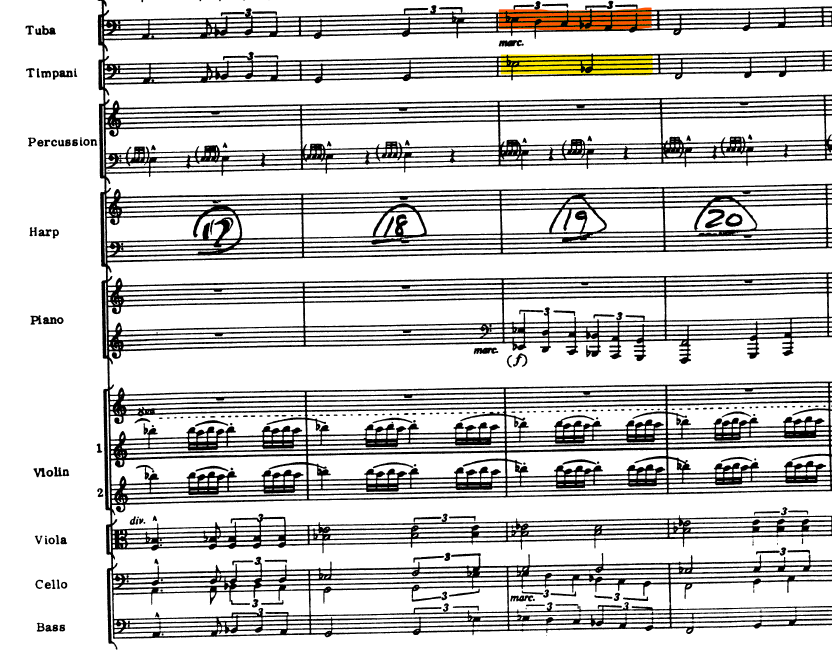
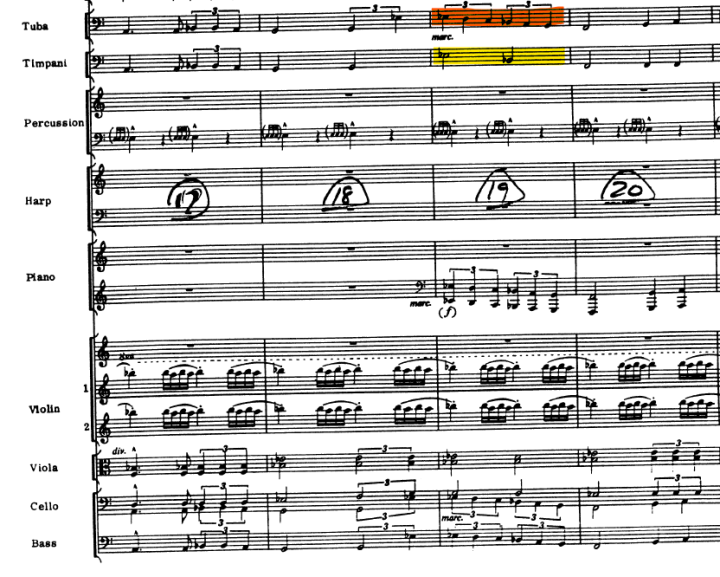
Here are some examples of the very minor orchestration changes. During the opening blast of the first fanfare, there was a triangle roll (part of that high shimmer) before the theme starts: No longer done in empire and after: The walking timpani line I mentioned is at 1:02 of Star Wars. It's not in empire and after. Star Wars timpani in yellow was doubling the tuba and low strings in red. It was simplified after as you see here in Hal Leonard. Don Williams (composer's brother and pro timpanist) considered the original bar not great orchestration finding it "too notey" and not easy to stabilize the intonation because they'd have to tune several of those notes. If the music is loud like it is here, it probably won't be noticed but it's considered awkward/temperamental with the revision being more idiomatic. It also says a lot about the level of perfectionism that goes into these scores that if given another chance to redo it, JW is always looking for how it could be improved even if it's something no one would really notice.
-
There is probably very minor tidying up but hard to notice. Another oddity that @Jay always sets me clear about this then I forget again is the main Star Wars theme. That is generally re-recorded for each film though I think in several films they simply reused it from an earlier recording. There are also very minor alterations. I know in a new hope there was a timpani walking line that was removed for empire (it became a repeated note), etc. I think to make things more complicated, sometimes the version on the OST is not the one used in the film. OST's are not records of what's in the film, they tend to be produced by the composer so the composer might have a preferred take that differs from what the producers/directors used.
-
That credit is just a contractual agreement and is not fully true in either of those cases. I know orchestrators who worked on both those trilogies. I recall talking to the late David Cripps about recording Return of the Jedi and I'm going off memory so forgive if I get some of the specifics wrong. They recorded in several studios for various reasons like re-edits to the film or preferred venue was booked and the schedule was slipping. At the smaller studio he said it was considerably difficult; the orchestra couldn't hear each other as they were way too many players for the studio size. This is partially why there is wide range of recorded quality in the Return of the Jedi. Some of that included the re-recorded cues like Here they Come but my understanding is that was planned but would have been a new recorded version. There might be more details because it seems they used it as temp music and just agreed it was fine but I'd be surprised JW wouldn't want to rework it a bit rather than have it straight from Star Wars. For Stanley & Iris, it looks like he did use his then regular orchestrators but also the score was small so it might have been a very minor job like just a few cues needed them.
-
I was an orchestrator for Chris Young on several films. Ask away!
-
What Is The Last Film You Watched? (Older Films)
karelm replied to Mr. Breathmask's topic in General Discussion
I just saw Cloud Atlas. A bit of a mess. I like the premise but feel it would have worked better as a manga but as a film, it's overly long and jarring story telling. Jarring could be fine if concise like Sin City and Pulp Fiction but they also give episodes time to themselves. This film literally flips epoch's mid thought for much of the run time. It might have been better if they gave each epoch 20 minutes straight then jumped and tide it all up just at the end where they could have done a flip through of the various timelines in a few minutes. -
Very interesting...will check it out as well!